

Back in September I wrote about California’s BEAD plan going final and what the satellite awards mean for the North Coast. The CPUC ratified the revised plan unanimously on September 17. I ended that post by saying the next milestones were signed agreements, then construction.
It turns out there’s one more step before any of that, and it’s a big one. To actually receive the roughly $1.42 billion, California has to sign NTIA’s award terms, and those terms include a clause called Condition 50. The decision is due in the first days of November (coverage has put the deadline at November 1 or 2), so this week is when it gets decided.
I’m not a lawyer, and this isn’t legal analysis. But a lot of the people I work with live and run businesses in places BEAD is supposed to reach, so here’s what I understand is going on and what I’d do about it.
What Condition 50 says
As reported by Stanford’s Center for Internet and Society and others, Condition 50 requires a state taking BEAD money to commit that it won’t enforce laws, regulations or other obligations that regulate broadband rates, terms and conditions, or that impose net neutrality, open access or other “utility-style” rules on BEAD subgrantees.
Barbara van Schewick at Stanford, who has been the loudest voice on this, groups what’s at risk into three buckets: affordability, net neutrality and public safety. Stanford’s estimate is that the condition would take those protections off the table for about 14 years.
The obvious example is California’s 2018 net neutrality law, SB 822, which bars providers from blocking or throttling lawful traffic and from paid prioritization. Part of what pushed that law and the first-responder protections around it was the 2018 wildfire in which a fire department’s data service was throttled mid-incident. Up here, where fire season and PSPS events are a fact of life, that history isn’t abstract.
Who’s pushing back, and how hard
The pressure on the governor has been building for over a month:
- September 15: a coalition of digital equity advocates sent Governor Newsom a letter urging him not to accept the award with Condition 50 in it.
- September: Public Knowledge argued that California would be trading somewhere between $5 billion and $16 billion in existing broadband protections and benefits for $1.42 billion of BEAD money paid out over years.
- Mid-October: The Utility Reform Network (TURN), along with consumer advocates, telecom experts and labor representatives, urged Newsom not to accept the funding unless Condition 50 is removed.
- October 19: The American Prospect laid out how the condition could effectively nullify California’s internet protections.
The argument Stanford keeps making is the most interesting one to me: California doesn’t have to choose between the money and its laws. The state could challenge Condition 50 in court before signing and ask to have it struck from the award. That’s a legal strategy, and I have no idea how a judge would rule. But it means the choice isn’t simply “take it or leave it.”
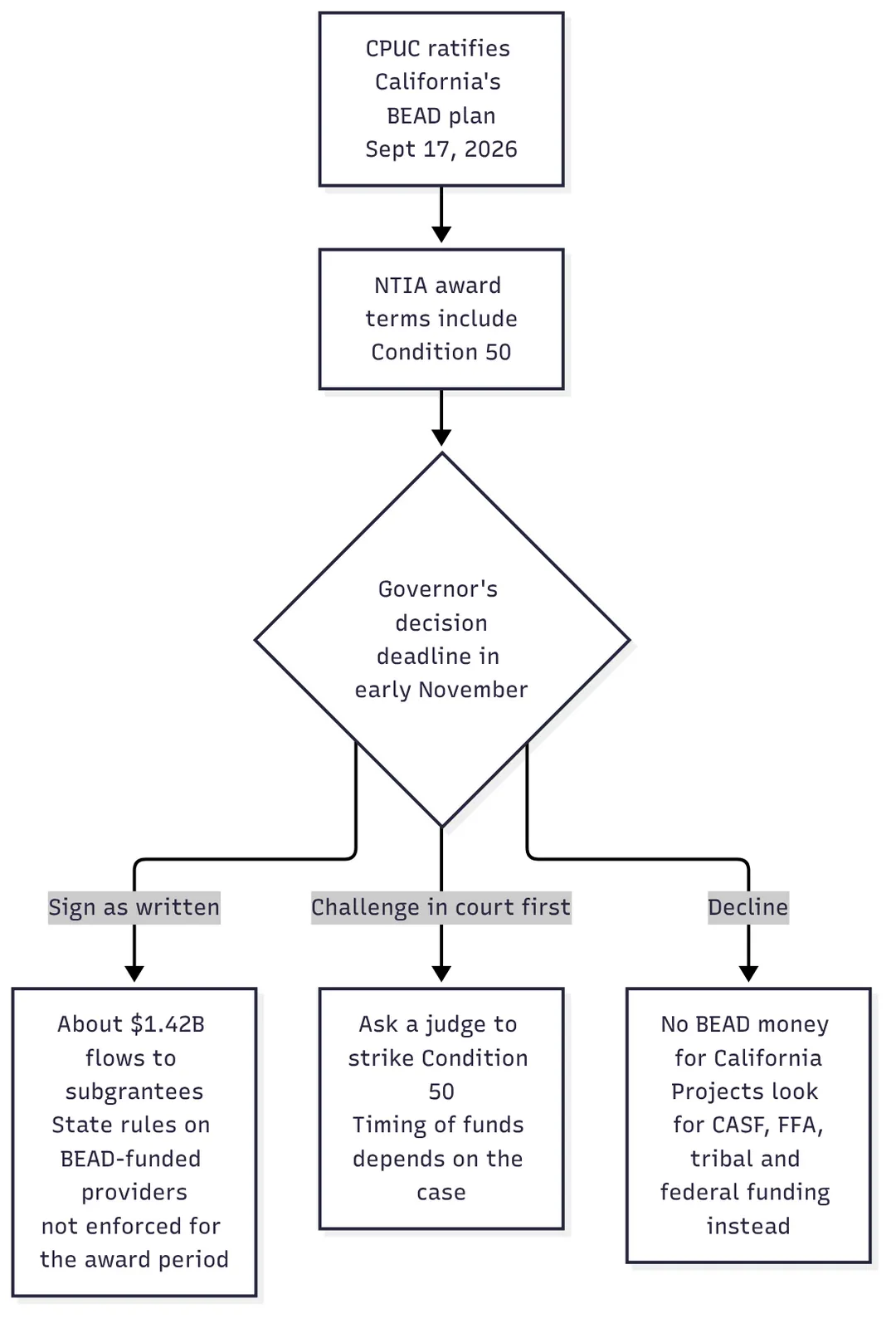 The three ways this can go, as I understand them.
Why the North Coast should care either way
If you read my September post, you’ll remember what the project data showed for our area: the two low-earth-orbit satellite awards (Amazon Kuiper and SpaceX) intersect tribal lands across the region, including the Hoopa Valley, Yurok, Karuk and Round Valley reservations, and Siskiyou Telephone appears on the terrestrial side. Those awards are part of the $1.42 billion.
So there are two ways rural customers up here get affected:
- If the state signs as written, the BEAD projects move ahead, and the providers building them operate without the state rules Condition 50 covers for the life of the grant. For a household or a small business on a BEAD-funded connection, that’s the affordability and net neutrality piece.
- If the state declines or ends up in court, BEAD money for our area is delayed or doesn’t come at all, and the projects that need it go back to competing for CASF, the CPUC’s Federal Funding Account, tribal programs and federal grants that were already oversubscribed.
There isn’t an option on that list where nothing changes for us. That’s why I think it’s worth paying attention this week even if you’ve tuned BEAD out.
What I’d do while this plays out
Here’s what I tell clients on rural properties: don’t put a security or IT project on hold waiting for a federal program to settle. BEAD timelines were long before this, and now there’s a legal question sitting on top of them.
- Design for the connection you have. Record video locally, keep access control decisions on the controller, and treat the internet as the path for viewing and alerts, not for moving video off site.
- Plan to change providers later. If a fiber or fixed wireless option shows up in two or three years, you want the network ready for it: a gateway that can take a second WAN, and no hard dependency on one ISP’s equipment.
- Write down what you actually get. When providers, the CPUC or a broadband consortium ask about service in your area, numbers beat anecdotes. That data also helps if you ever need to challenge what a map says about your address.
That last one is easy to automate. This is a small Bash script I’d run from cron on any always-on Linux box at a site (a Raspberry Pi is plenty). It uses the open-source speedtest-cli package and appends one CSV line per run.
#!/usr/bin/env bash
# Log one speed test per run to a CSV file. Install first: pip install speedtest-cli
set -euo pipefail

LOG="${HOME}/speedlog.csv"

# cron runs with a minimal PATH, so add the usual pip install locations
export PATH="${HOME}/.local/bin:/usr/local/bin:/usr/bin:/bin"

# Write the header once
if [[ ! -s "$LOG" ]]; then
  speedtest-cli --csv-header > "$LOG"
fi

# Append a result; record a failure line instead of exiting if the test can't run
if ! speedtest-cli --csv --secure >> "$LOG" 2>/dev/null; then
  echo ",,,$(date -u +%Y-%m-%dT%H:%M:%SZ),,,,,FAILED," >> "$LOG"
fi
Save it as ~/speedlog.sh, make it executable with chmod +x ~/speedlog.sh, and schedule it every few hours with crontab -e:
15 */3 * * * /bin/bash /home/pi/speedlog.sh📝 Note: the download and upload columns in speedtest-cli CSV output are in bits per second, so divide by 1,000,000 for Mbps. Also log failures, as the script does: on a rural link, when it drops out often matters more than the peak speed.
The bottom line
California has to decide in the next week whether to take its BEAD money with Condition 50 attached, fight the condition first, or walk away. Each of those paths changes what rural broadband on the North Coast looks like for the next decade, either in what the rules are or in when the money shows up.
I’ll write a follow-up once there’s a decision. In the meantime, if you’re planning a camera, access control or network project on a rural property and you’re unsure whether to wait for “the fiber that’s coming,” get in touch. I’d rather help you build something that works on today’s connection and is ready for tomorrow’s.
Sources
- California Is Being Asked to Give Up 14 Years of Broadband Protections. It Doesn’t Have To., Stanford Center for Internet and Society, September 2026
- Letter to Governor Newsom re: BEAD Term 50, digital equity advocates, September 15, 2026
- Federal Broadband Grant Fine Print Would Strip California Net Neutrality for 14 Years, Tech Times, September 20, 2026
- The Trump Admin Wants California To Trade Up to $16 billion in Broadband Benefits It Has Now for $1.42 billion It Will Disperse Later, Public Knowledge, September 2026
- CPUC Ratifies California’s BEAD Proposal, Communications Daily, September 21, 2026
- Gov Newsom Urged to Reject $1.4 Billion from BEAD over Net Neutrality, Benton Institute for Broadband & Society, October 2026
- Trump Administration Could Nullify California Internet Protections, The American Prospect, October 19, 2026