
Most of the broadband news I’ve written about this fall has been about money stuck in Sacramento and Washington. Last week I covered California signing its BEAD award while contesting Condition 50, and the short version was that BEAD subgrants are on hold until that dispute is settled.
So it’s good to have a local project that’s actually moving. On Thursday, November 5, the Hoopa Valley Public Utilities District put out an update on its Hoopa TRAIL fiber project: design is in progress, aerial and underground engineering is underway, permits are being prepared, and site surveys are finished in all seven project communities. That puts fiber-to-the-home on the map for parts of Willow Creek, the Highway 299 corridor in Trinity County and Douglas City.
This post covers what was announced, what it does and doesn’t mean yet, and what I’d do now if I were a home or business owner in the project area.
What was announced
From the November 5 update (republished by Redheaded Blackbelt) and the earlier announcements linked at the end:
- Who’s building it. The Hoopa Valley Public Utilities District (HVPUD), a chartered entity of the Hoopa Valley Tribe. Service will be sold under Acorn Connected, HVPUD’s communications division.
- Where it stands. Fiber design is in progress, aerial and underground engineering is underway, and permit preparation is in process. Construction hasn’t started.
- Surveys are done. Site surveys are complete in Willow Creek, Salyer, Hawkins Bar, Big Bar, Junction City, Lewiston/Bucktail and Douglas City.
- Who this phase serves. Only eligible properties inside the funded project area: portions of Willow Creek, select locations along Highway 299 in Trinity County, and portions of Douglas City.
- Installation cost. Installation is free for eligible properties during the grant-funded window.
The timeline from HVPUD’s August announcement still stands as far as I can tell: construction is anticipated to begin in early 2027 and wrap up by December 2027.
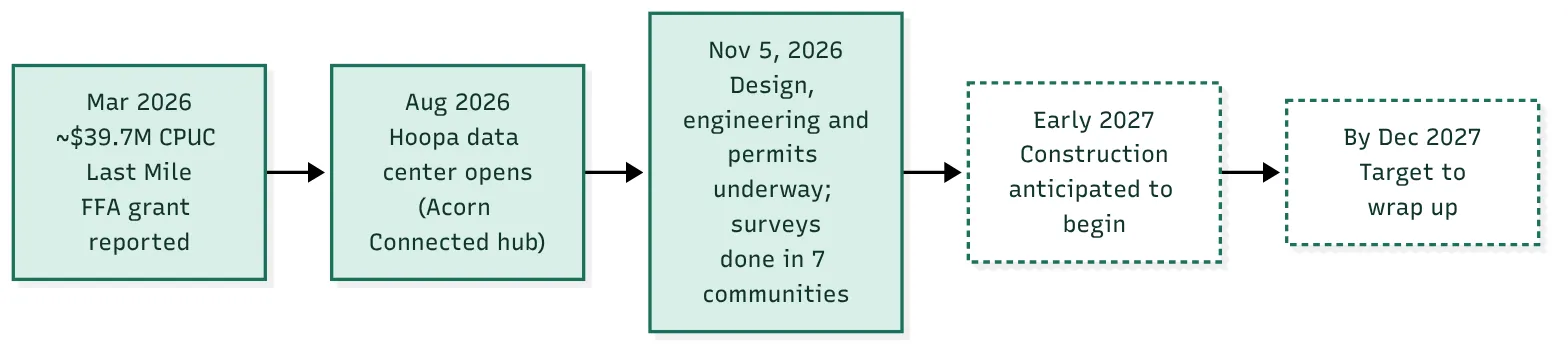 Where TRAIL is now. The two dashed boxes are targets, not dates anyone has promised.
Where the money comes from
TRAIL is funded through the CPUC’s Last Mile Federal Funding Account (FFA), not BEAD. In March, Lost Coast Outpost reported the award at about $39.7 million, and the CPUC’s April presentation on tribal broadband lists it at $39,789,177. That’s why this project isn’t caught up in the Condition 50 standoff: it’s a different pot of money with its own rules and deadlines.
The tribe’s March announcement described a build of more than 100 miles of fiber across the seven communities. I’d read the November update carefully, though: it says this phase covers only eligible properties in portions of Willow Creek, select locations along 299 and portions of Douglas City. The scope figures in different documents don’t line up perfectly, which is normal for a project moving from grant application to engineering. If you’re in Salyer or Big Bar, a completed site survey is a good sign, but it isn’t the same as being in this phase’s footprint. Check your own address.
There’s also real infrastructure behind it already. In August, the tribe opened a new data center in Hoopa as the hub for Acorn Connected. Local network operations matter up here, where a single cut on a long route can take a whole area offline.
What this means for homes and businesses in the project area
Fiber to the property is a different class of connection from what most of the 299 corridor has today. Compared to satellite, fixed wireless or long copper runs, it’s typically lower latency, much less sensitive to weather and trees, and capable of the same speed up as down. That last part matters more than people expect. Upload is what carries camera footage to your phone, backups to the cloud and your side of a video call.
But fiber arriving at the road is the start of the job, not the end. Here’s what I’d do between now and construction.
1. Confirm eligibility and sign up during the free window
Free installation during the grant window is the most valuable part of this announcement for anyone at the end of a long driveway. A long drop from the road to a house or shop can be expensive outside a program like this. Check your address on Acorn Connected’s TRAIL page (linked in the August announcement below) and get on the list.
2. Decide where the fiber comes in
Before a crew shows up, decide where you want the fiber to enter the building and where the fiber terminal (often called the ONT) will live. My rule of thumb:
- Put it where your network equipment is, or where it will be: a closet, an office, a utility room. Not behind the TV because that’s where the old modem was.
- Give it power on a UPS. A fiber terminal with no battery backup means no internet in a power outage, and outages are common out here.
- Plan the inside wiring. If the shop, the house and the gate camera are in different buildings, that’s an inside-the-property network design question, and it’s worth answering before the fiber arrives.
3. Don’t cancel what you have yet
Keep your current service until fiber is installed, live and has run well for a few weeks. After that, think about keeping a cheaper version of the old connection, or an LTE or satellite plan, as a backup. One fiber line is still one line. For a business that takes card payments, runs VoIP or has cameras, a second path is cheap insurance.
4. Ask about public IP addresses
If you run anything that needs to be reached from outside (a camera recorder, a VPN, a remote-access tool for a gate controller), ask the provider whether you’ll get a public IP address and whether a static one is available. A lot of rural services put customers behind carrier-grade NAT. Systems that connect outbound to a cloud service work either way, but anything that relies on port forwarding will need to be planned.
5. Get a baseline of your current connection
This is the part people skip. When fiber arrives you want to be able to say “here’s what we had, and here’s what we have now,” and spot problems in the first few weeks. A small Linux box, a Raspberry Pi or a NAS that can run scripts is enough.
Here’s the script I’d drop on a client’s always-on Linux machine. It pings a couple of well-known public resolvers 20 times each and appends packet loss and latency to a CSV:
#!/usr/bin/env bash
# wan-baseline.sh: log packet loss and latency to a CSV.
# Run it from cron every 5 minutes. Use at your own risk.
set -euo pipefail

LOG="${1:-$HOME/wan-baseline.csv}"
TARGETS=("1.1.1.1" "8.8.8.8")

[[ -f "$LOG" ]] || echo "timestamp,target,loss_pct,avg_ms,max_ms" > "$LOG"

for t in "${TARGETS[@]}"; do
  out=$(ping -c 20 -i 0.5 -q "$t" 2>&1 || true)
  loss=$(grep -oP '[\d.]+(?=% packet loss)' <<<"$out" || true)
  # No summary line means ping itself failed (bad name, no permission),
  # not that the WAN dropped every packet. Skip the sample and say why.
  if [[ -z "$loss" ]]; then
    echo "wan-baseline: ping to $t failed, sample skipped: $out" >&2
    continue
  fi
  # The rtt line looks like: rtt min/avg/max/mdev = 21.1/24.3/40.2/3.9 ms
  stats=$(grep -oP '= \K[\d.]+/[\d.]+/[\d.]+' <<<"$out" || true)
  avg=$(cut -d/ -f2 <<<"$stats")
  max=$(cut -d/ -f3 <<<"$stats")
  echo "$(date -Iseconds),$t,$loss,${avg},${max}" >> "$LOG"
done
Make it executable and schedule it:
chmod +x /usr/local/bin/wan-baseline.sh
( crontab -l 2>/dev/null; echo '*/5 * * * * /usr/local/bin/wan-baseline.sh "$HOME/wan-baseline.csv"' ) | crontab -
After a week or two, this one-liner gives you average latency, worst latency and the number of samples with any loss for each target:
awk -F, 'NR>1 { n[$2]++; if ($3>0) l[$2]++
                if ($4!="") { k[$2]++; s[$2]+=$4; if ($5>m[$2]) m[$2]=$5 } }
         END { for (t in n) {
                 avg = k[t] ? sprintf("%.1f ms", s[t]/k[t]) : "N/A"
                 worst = k[t] ? sprintf("%.1f ms", m[t]) : "N/A"
                 printf "%s  avg %s  worst %s  samples with loss: %d of %d\n", t, avg, worst, l[t], n[t] } }' ~/wan-baseline.csv
📝 Note: If you already run LibreNMS, its Smokeping integration does the same job with graphs. The script above is for when you just want numbers in a file without standing up a monitoring server.
What I’m watching
The next milestone is the start of construction, which HVPUD expects in early 2027. Between now and then, the things worth watching are permit approvals, the final eligible-address list for this phase, and whether the communities that were surveyed but aren’t in this phase’s footprint get a timeline of their own.
It’s also worth saying plainly: this is a tribal utility building fiber into some of the hardest terrain in the state, with a local data center behind it. That’s the kind of project the North Coast needs more of, and it isn’t waiting on the BEAD fight to get started.
If you’re in Willow Creek or along 299 and want help planning the inside of your network before fiber shows up (where it lands, cabling between buildings, backup internet, cameras and gate access that work on whatever connection you have), get in touch. I’ll write a follow-up when construction starts.
Sources
- Hoopa TRAIL Project Advances Fiber Design and Engineering for Willow Creek and Trinity County Communities, Redheaded Blackbelt (HVPUD press release), November 5, 2026
- Hoopa TRAIL Project Will Bring Local Fiber-Optic Internet Service to Portions of Willow Creek and Trinity County, Redheaded Blackbelt, August 6, 2026
- Hoopa Valley Tribe Celebrates the Opening of its New Data Center, the Hub of Broadband Expansion in the Valley and Beyond, Lost Coast Outpost, August 5, 2026
- Tribal Broadband Across California, California Public Utilities Commission, April 2026
- Hoopa Valley Tribe Gets Nearly $40 Million Grant to Deliver Fiber Optic Service Throughout the Valley and Beyond, Lost Coast Outpost, March 24, 2026