
On October 26 I wrote about Condition 50, the clause in NTIA’s BEAD award terms that would stop California from enforcing a range of its own broadband rules against funded providers, and the deadline the state was facing to decide whether to sign. I said I’d write a follow-up once there was a decision.
There is one, sort of. On Monday, November 2, the California Public Utilities Commission signed the state’s BEAD Notice of Award and sent it back to NTIA, making California the last of the 50 states to sign. It also sent a letter saying, in effect, we’re signing, but we don’t agree with Condition 50 and we’re not giving up our rights. NTIA’s answer was that the letter isn’t part of the deal.
So California has accepted roughly $1.42 billion and, at the same time, started a fight over the terms. For anyone waiting on BEAD money to bring broadband to a rural North Coast address, the detail that matters most is in the letter, and it’s about timing.
What the CPUC actually did
From the CPUC’s November 2 letter to NTIA Administrator Arielle Roth and the coverage linked at the end:
- It signed. The CPUC sent its signed Notice of Award to NIST and NTIA, with a letter laying out how it understands its obligations.
- It called Condition 50 vague. The letter says Section 50 of NTIA’s November 2025 updated terms is “vague and ambiguous” as to its scope, and that the CPUC’s acceptance is based on its best understanding of what Section 50 does.
- It reserved its rights. The letter says the CPUC doesn’t waive any legal rights or defenses and can’t be bound by terms that are unconstitutional or not authorized by law. Coverage notes it cites California Civil Code section 3104, part of the state’s net neutrality law, which says a waiver of that law is contrary to public policy and unenforceable.
- It put subgrants on hold. This is the big one. The CPUC says it will execute BEAD subgrant agreements, the contracts with the providers who will actually build, only once its disagreements with NTIA are resolved. CalMatters put it plainly: the state won’t distribute funding to companies like Comcast, Pacific Bell, SpaceX and Verizon until then.
Governor Newsom’s office framed it as California taking the money while keeping its net neutrality protections.
NTIA’s answer
NTIA didn’t budge. An agency spokesperson told reporters that the award’s terms and conditions are the entire agreement between NTIA and the CPUC, and that no part of the CPUC’s letter is incorporated into the award.
Barbara van Schewick at Stanford, who has led the argument against Condition 50, made the same point from the other side: a letter doesn’t remove the condition. Only a court, or a written agreement with NTIA, can do that.
I’m not a lawyer, and I’m not going to guess how that plays out. But you don’t need to be one to see the shape of it.
Why this matters on the North Coast
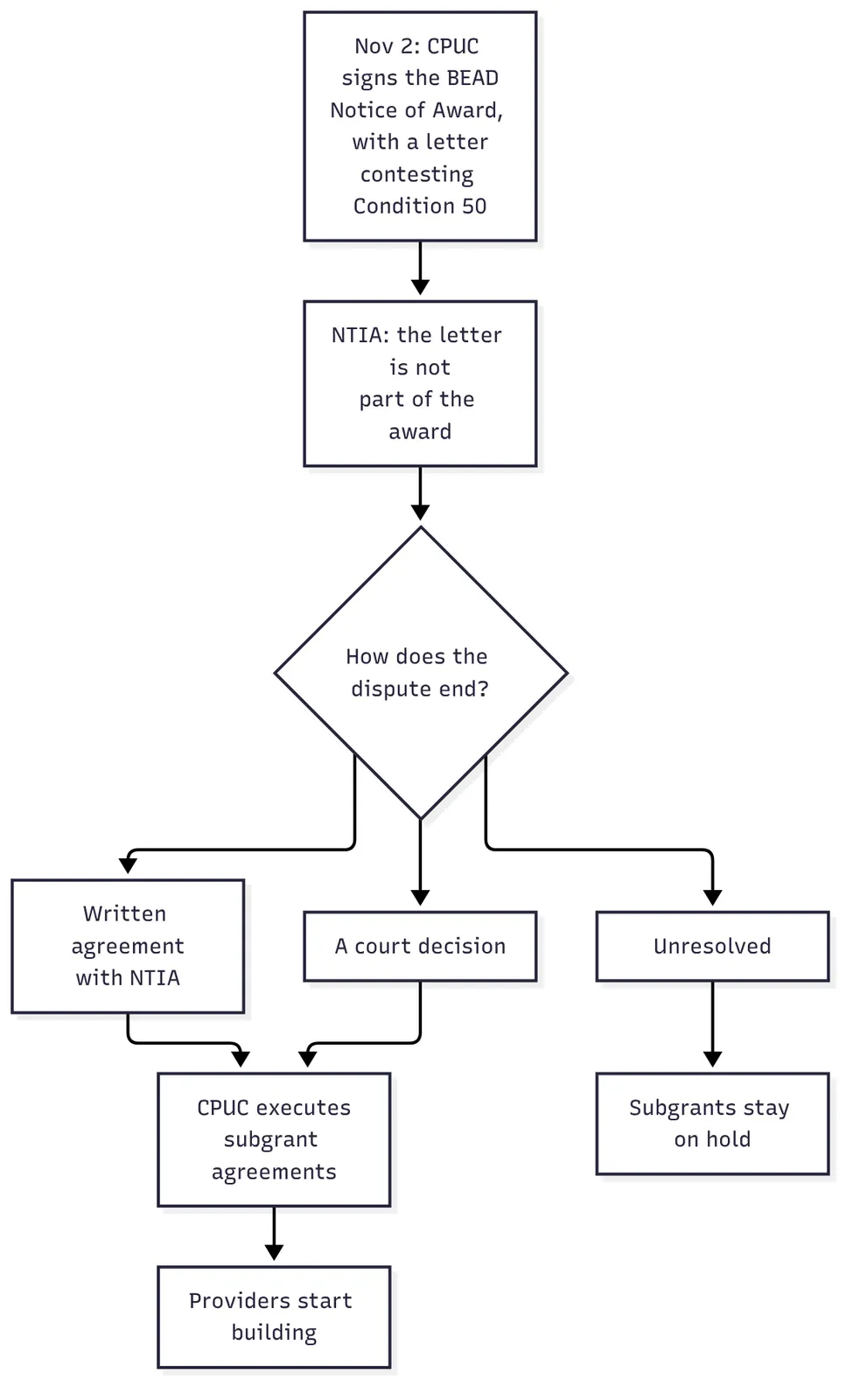 The path from Monday’s signature to anyone breaking ground. Every route to construction runs through subgrant agreements.
BEAD money doesn’t build anything until a subgrant agreement is signed with a provider. California has now tied those agreements to resolving a dispute that NTIA says doesn’t exist. Until one side moves, or a court decides, the projects in California’s final proposal are funded on paper and paused in practice.
That’s not nothing for us. As I covered in September’s post on the final plan, a lot of the rural addresses BEAD is meant to reach are the kind of places we work every week: ranches, gates, shops at the end of long roads, community buildings and tribal lands. Some are slated for fiber or fixed wireless, and a meaningful share for low earth orbit satellite. Whatever technology an address was assigned, it doesn’t arrive until the provider has a signed subgrant.
It’s also worth remembering that BEAD isn’t the only money moving up here. Tribal fiber projects like YTEL’s on the Klamath, which I wrote about in October, are funded through other programs. Nothing in Monday’s news changes those.
What I’d tell a client who’s waiting on BEAD
I get some version of “should I wait for the fiber that’s coming?” a lot. My answer hasn’t changed, but this week made it easier to explain:
- Plan for the connection you have today. If a camera system, a gate controller or a small office depends on the internet, design it around what actually reaches the property now, whether that’s satellite, LTE, a point-to-point link to a wireless ISP or a DSL line that’s seen better days.
- Record locally, sync when you can. Cameras that record on site and don’t need the cloud to work keep working when the uplink is slow or down. Remote viewing is a bonus, not the foundation.
- Connect outbound, don’t port forward. Many satellite and fixed wireless services put customers behind carrier-grade NAT. Systems that connect out to a vendor’s cloud, or over a VPN you start from the site, work the same on any connection, including the fiber that shows up later.
- Keep the inside of the network ready for a better uplink. Good cabling, a decent router and a sensible VLAN layout don’t care what the WAN is. When a better connection arrives, it should be a cable swap, not a redesign.
- Have a backup path for anything critical. A second connection on a different technology, like LTE behind satellite, is often cheaper than one bad day.
📝 Note: If you’re a North Coast resident or business and want to weigh in on how this money is used, the CPUC is the agency running BEAD in California, and it takes public comment. Local planning efforts like the Redwood Rural Reach project in Humboldt and Trinity counties are another way to get your community’s needs on paper before the next round of funding.
What happens next
Honestly, nobody knows yet. The realistic outcomes are a negotiated written agreement with NTIA, a court case, or a standoff that drags on. Each of those is a different amount of time before subgrants get signed, and each one moves the date anyone breaks ground.
I’ll keep watching it. In the meantime, if you’re planning cameras, access control or a network on a rural property and you’re unsure whether to wait, get in touch. I’d rather help you build something that works on today’s connection and is ready for whatever arrives.
Sources
- Letter from the CPUC to NTIA Administrator Arielle Roth on the BEAD Notice of Award, California Public Utilities Commission, November 2, 2026
- California accepts big broadband money from Trump — but not the terms and conditions, CalMatters, November 3, 2026
- California Public Utilities Commission Signs BEAD Notice of Award, Benton Institute for Broadband & Society, November 2026
- All 50 states’ BEAD final proposals signed, Benton Institute for Broadband & Society, November 2026
- NTIA Not Swayed by California Public Utility Letter on BEAD Conditions, Broadband Breakfast, November 2026
- Gavin Newsom Has Till Monday To Make Key Wildfire Safety Decision, KQED, October 2026