The client
The Mattole Salmon Group was formed in 1980 by Mattole Watershed residents determined to restore the remnant runs of native salmon. It was one of the first citizen-led watershed restoration organizations on the West Coast, and today it works through instream habitat restoration, salmon population monitoring, and education and outreach.
Its office is in the Mattole Valley, a long way from the nearest cable or fiber.
The challenge
Three problems were holding the team back:
- Unreliable internet. Frequent outages and slow performance disrupted everyday work.
- Files everywhere, and an exposed NAS. Data was spread across staff computers, large files were hard to share, and the network-attached storage (NAS) at headquarters relied on outdated, insecure FTP. That was a serious cybersecurity risk.
- Phone costs that kept climbing. Telephone service came from the same unreliable internet provider, and the price had become too high.
 Three problems, three changes.
What we did
A radio in a tree, and a better internet provider
Working with a local wireless internet service provider (WISP), we found a tree on the property with a clear line of sight to one of the WISP’s access points and mounted a Ubiquiti airMAX NanoBeam radio in it. That point-to-point link let the group drop its unreliable ISP for a steadier connection. Because the WISP runs its own backhaul, independent of the old provider’s lines, it also added route diversity: the office is no longer dependent on a single path out of the valley.
 The new connection: one point-to-point hop to the WISP, then its independent backhaul.
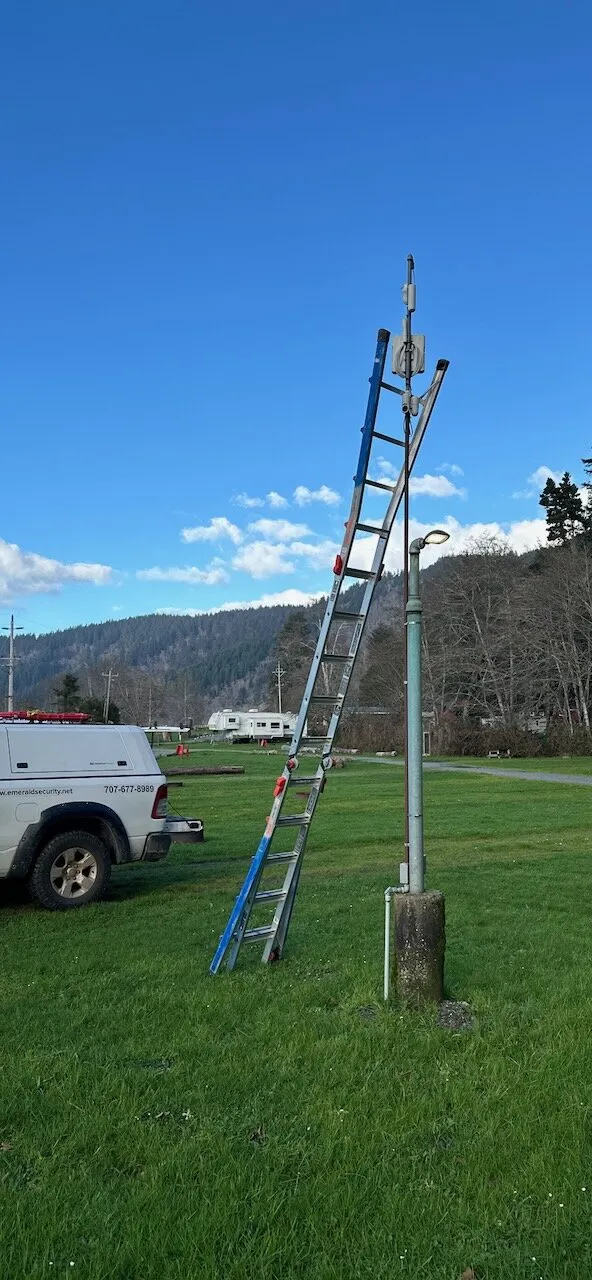 A point-to-point radio install of ours at a different site. At the Mattole Salmon Group, the radio is mounted in a tree.
Files in the cloud, and the NAS retired
FTP sends logins and files without encryption, and a NAS reachable from the internet is a common target. So rather than patch around it, we retired the NAS and moved the organization’s data to Google Workspace for Nonprofits. Staff can now reach shared files from the office, the field or home, share large files without workarounds, and work on the same documents together, with Google’s security protections in place of an aging box on the internet.
Phones that work with everything else
The group’s phone service moved from the old provider to Google Voice, which works with the free Google Workspace for Nonprofits edition the team was already using. Phones now live in the same Google account as email and files, rather than on a separate bill from an ISP the group no longer needed.
The result
The office has a steadier internet connection with a second, independent path out of the valley. Its files live in one secure place that staff can reach from anywhere. The FTP-exposed NAS is gone, and phones run on the same platform as everything else.
Working from somewhere the cable doesn’t reach?
Small offices and nonprofits in rural valleys face the same mix: unreliable internet, files on old hardware, and phone bills that keep rising. We’ll look at what can reach your site and what you’re running today, then recommend only what fits. See Rural connectivity and Managed IT.