
On September 16, 2026, the California Public Utilities Commission published a feature on Yurok Telecommunications Corporation (YTEL), the Yurok Tribe’s telecom company, and its fiber-to-the-home project. The CPUC describes a Last Mile Federal Funding Account project covering about 120 square miles, from the Klamath and Requa area in Del Norte County down to Orick in Humboldt County, that will benefit 2,491 people. Yurok Tribal Chairman Joseph James praised the investment.
That’s a feel-good press piece, but it’s also a good moment to step back and look at what’s actually being built along the lower Klamath, because it isn’t one project. It’s several, paid for by different agencies, that only work together. If you live, work or run a business between Crescent City and Orick, here’s how the pieces fit, what’s confirmed and what isn’t, and how I’d get a site ready for the day fiber shows up.
The pieces, and who’s paying for them
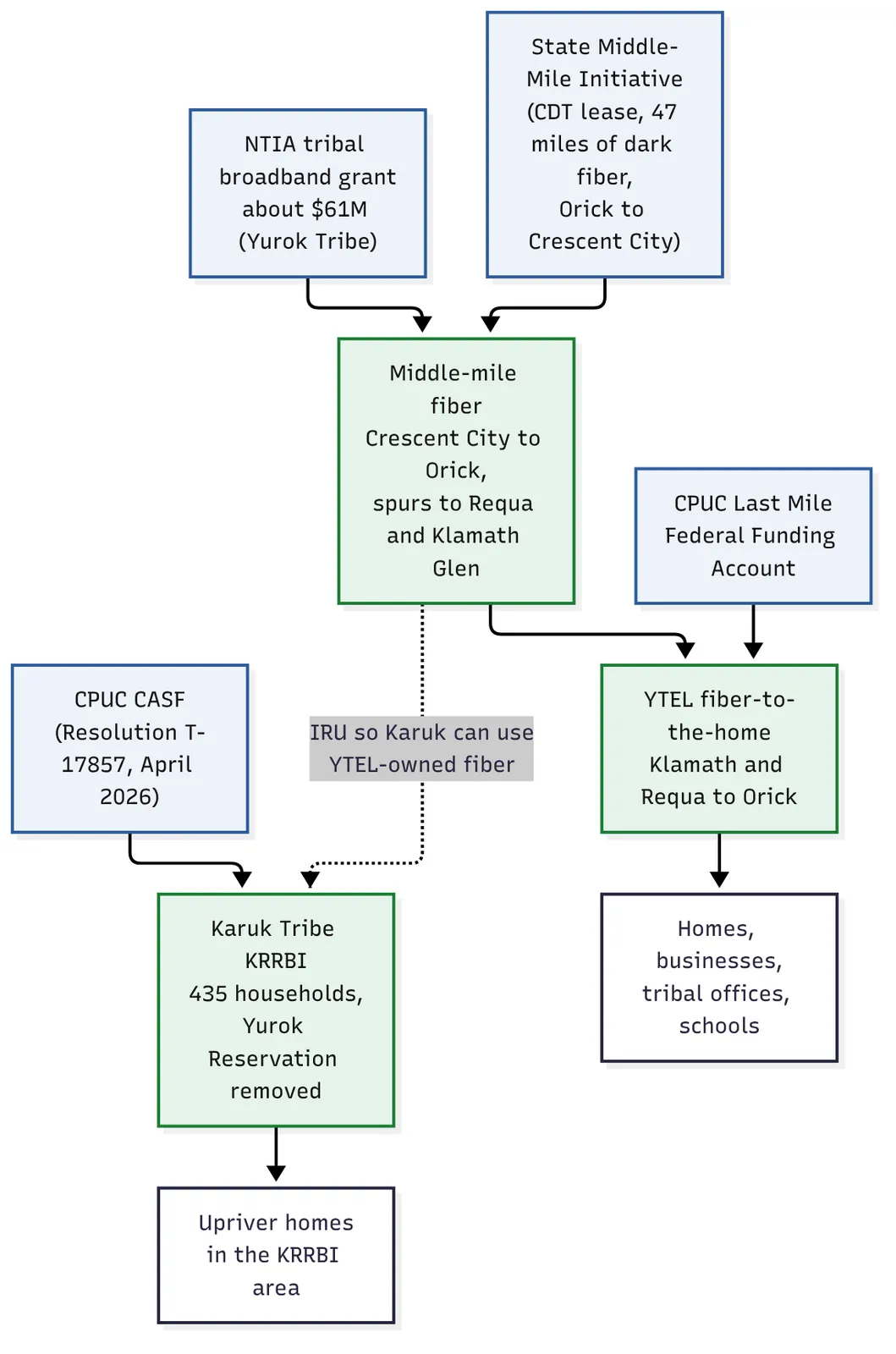
The diagram above is my map of the funding. Here’s the same thing in words.
Middle mile: NTIA and the state
The backbone is middle-mile fiber running between Crescent City and Orick. YTEL says a $61 million federal grant through NTIA funds fiber from Orick to Crescent City plus new towers for wireless coverage. Project filings for the NTIA-funded work describe 62 miles of fiber from Crescent City to Orick, with spurs from the main line to Requa and Klamath Glen.
The state is involved too. In July 2025, the California Department of Technology announced a lease of 47 miles of dark fiber from Orick to Crescent City as part of the state Middle-Mile Broadband Initiative. That same month, the Yurok Tribe held a groundbreaking for four broadband projects, including roughly 50 miles of middle-mile fiber from Klamath through Crescent City to Weitchpec, which the Tribe said would bring broadband to more than 2,000 locations.
Last mile: the CPUC
Middle mile doesn’t connect anybody’s house. The last-mile piece is YTEL’s fiber-to-the-home project, the one the CPUC wrote about on September 16. A Notice of Exemption filed in May 2026 (CEQAnet, referencing CPUC Resolution T-17907) describes a 116-mile FTTH build in Del Norte and Humboldt counties, entirely within the Yurok Reservation and ancestral territory. It says 15 miles of middle mile are paid for by the NTIA award, so the CPUC request covers last-mile construction and access equipment only.
A CPUC presentation on tribal broadband from April 2026 lists YTEL’s fiber-to-the-home project at $19,602,036, with 13 miles of tribally owned underground fiber and connections to about 300 locations. Those figures don’t line up neatly with the 116-mile and 120-square-mile numbers above, and I suspect they describe different scopes or phases. I’d treat the CPUC’s September feature as the current description and ask YTEL directly if you need numbers for your address.
Upriver: the Karuk Tribe’s KRRBI
The Karuk Tribe’s Klamath River Rural Broadband Initiative (KRRBI) has been in the works since the CPUC first funded it in October 2013 (Resolution T-17418, $6,602,422), with more funding added in May 2020 (Resolution T-17690, $10,820,150). On April 30, 2026, the CPUC adopted Resolution T-17857, which:
- Adds up to $10,514,163 from the California Advanced Services Fund, tied to changes in permitting, engineering and wage laws since 2013.
- Removes 181 of the originally approved 616 households, leaving 435.
- Removes the Yurok Reservation from the project area, at the Yurok Tribe’s request, with middle-mile fiber on the reservation to be built, owned and maintained by YTEL.
- Requires an Indefeasible Right of Use (IRU) between the Karuk Tribe and YTEL so the Karuk project can use the infrastructure it needs.
That last point is the one I’d underline. The upriver project depends on fiber the downriver project owns. The two tribes’ builds are now separate on paper and connected in practice.
What’s confirmed and what isn’t
- Confirmed: the funding above, the project areas, and that construction started with the July 2025 groundbreaking.
- Stated as a plan: YTEL’s own FAQ says it runs a wireless network today and will begin offering fiber internet service in 2026. YTEL’s NTIA page put the rollout of new services at winter 2025 through summer 2026.
- Not confirmed: I couldn’t find a public announcement that fiber service is live for customers yet, or a map of which addresses are first. If you’re in the area, YTEL is the one to ask.
Why this matters beyond the reservation
New fiber between Crescent City and Orick matters to everyone along that stretch of 101, not just YTEL’s customers. When the only path out is a single cable or a microwave hop, one cut or one storm takes out internet, phones, card readers and camera uploads at the same time. More fiber in the ground is how a region starts getting out of that.
It also changes what’s practical for small businesses there. Cloud backup, VoIP, offsite camera recording and remote management all assume a link that’s fast in both directions and doesn’t drop when it rains. Fixed wireless and satellite can do a lot, but fiber is a different class of service.
How I’d get a site ready for fiber
When a client’s area is about to get fiber, here’s what I tell them to do before the installer shows up:
- Measure what you have now. You can’t tell whether the new service is better, or hold anyone to a promised speed, without a baseline. The script below logs latency, packet loss and download speed to a CSV.
- Ask the provider the boring questions. Upload speed, not just download. Static IP availability and cost. Whether you’ll be behind carrier-grade NAT (CGNAT), which breaks some VPN and port-forwarding setups. What equipment they hand off and whether you can put your own router behind it.
- Keep a backup link. Fiber is more reliable, not invincible. I’d keep an LTE or satellite connection on a dual-WAN gateway with automatic failover, especially for businesses that take cards or record cameras offsite.
- Plan the cutover. Write down every port forward, VPN tunnel, DNS record and camera remote-access setting that depends on your current public IP. Those are the things that quietly break on cutover day.
- Revisit your backup and camera plans. With real upload bandwidth, offsite backup and cloud-assisted video retention may finally be practical. Do the math on upload before you turn anything on.
A simple baseline logger
This Bash script appends one line per run to a CSV: timestamp, average ping, packet loss and download speed. Run it from cron every 30 minutes for a week before cutover and a week after, and you’ll have a real comparison instead of a feeling.
#!/usr/bin/env bash
# Log latency, packet loss and download speed to a CSV.
# Usage: ./linklog.sh [csv-file]   (cron: */30 * * * * /usr/local/bin/linklog.sh)
set -uo pipefail

out="${1:-$HOME/linklog.csv}"
target="1.1.1.1"
# 25 MB test download from Cloudflare's speed test endpoint
url="https://speed.cloudflare.com/__down?bytes=25000000"

[[ -f "$out" ]] || echo "timestamp,avg_ms,loss_pct,down_mbps" > "$out"

ping_out=$(ping -c 20 -q "$target" 2>/dev/null)
loss=$(grep -oE '[0-9.]+% packet loss' <<<"$ping_out" | cut -d% -f1)
avg=$(awk -F'/' '/^rtt|^round-trip/ {print $5}' <<<"$ping_out")

bps=$(curl -s -o /dev/null -w '%{speed_download}' --max-time 60 "$url")
mbps=$(awk -v b="${bps:-0}" 'BEGIN {printf "%.1f", b * 8 / 1000000}')

echo "$(date -Iseconds),${avg:-NA},${loss:-100},${mbps}" >> "$out"
📝 Note: A 25 MB download is enough to see the difference between a wireless link and fiber without burning through a metered or capped connection. If you’re on a data cap, drop the size or the frequency.
Once you have a week of data, open the CSV in a spreadsheet and look at the worst hours, not the average. The evening slowdown and the packet loss during storms are what your staff actually notice.
The bottom line
The lower Klamath is getting a real fiber network, built by a tribal company with federal and state money, and it’s tied to the Karuk Tribe’s upriver project through shared infrastructure. Service dates are still a plan rather than a promise, so if you’re in Klamath, Requa, Klamath Glen or Orick, get your baseline now, ask YTEL the questions above, and have your network ready to cut over cleanly when it’s your turn.
Sources
- YTEL and the CPUC Work Together to Build Tribal Broadband Connectivity, CPUC, September 16, 2026
- YTEL FTTH Yurok Telecommunications Corporation (T-17907), Notice of Exemption, CEQAnet, May 2026
- Resolution T-17857: Karuk Tribe Klamath River Rural Broadband Initiative, CPUC, April 30, 2026
- Tribal Broadband Across California (presentation), CPUC, April 2026
- National Telecommunication Information Administration, Yurok Telecommunications Corporation
- FAQ, Yurok Telecommunications Corporation
- Yurok Telecommunications Broadband, CEQAnet, February 2025
- Yurok Tribe Celebrates Start of Four Broadband Projects, Yurok Tribe, July 2025
- California Surges Forward to Close the Digital Divide in North Coast Tribal Communities, California Department of Technology, July 2025