
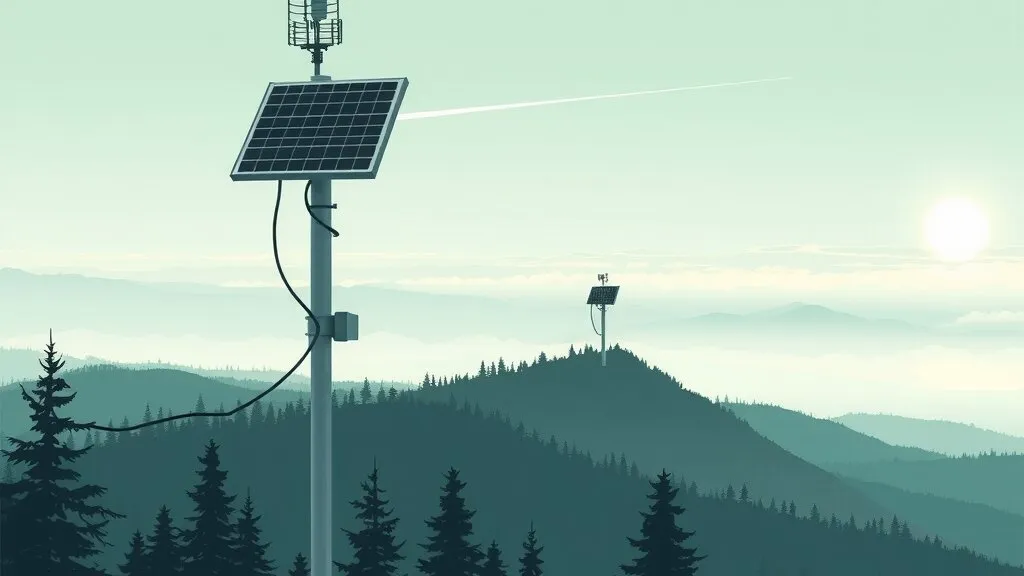
A point-to-point wireless bridge is one of the most useful tools we have for rural properties. Put a radio where the internet is, put another where you need it, aim them at each other, and you’ve carried a connection across a field, a canyon or a ranch without trenching a foot of cable.
The catch is in the word “aim.” A point-to-point link needs a clear line of sight between the two radios. Up here, that’s often the one thing you don’t have. Between the place where service is available and the place that needs it, there’s a ridge, or a stand of redwoods and fir, or both.
This post is about what we do when the direct path is blocked: we build solar-powered relay sites that carry the link around the obstacle, one hop at a time. With winter coming on, it’s also a good time to talk about the part that makes or breaks these sites, which is keeping them powered when the sun doesn’t show up for days.
The problem: no straight line from here to there
The situation usually looks like this. A property deep in the hills has no wired broadband. Somewhere within reach there’s a source of internet: a neighbor’s connection, a building on the same land with service, or a wireless ISP’s equipment. The two points might not be all that far apart, but the terrain between them is the problem.
The obvious fixes don’t work here:
- A direct radio link fails because the signal can’t pass through a hillside, and dense, wet forest absorbs and scatters it.
- A taller mast helps sometimes, but not when the obstacle is a ridge, or trees that are taller than anything you’d want to put up.
- Running cable to a better spot isn’t practical over rough ground and long distances, and there’s no power out there to run equipment anyway.
What we did: add relay sites on solar power
If you can’t go straight through, you go around. We find spots that can see both ends, usually a high point or a clearing on the way, and put a relay there. Each relay site is one or more Ubiquiti airMAX radios, linking back toward the source and on toward the next hop. The relays act as extra hops in the wireless backhaul, so the signal steps around the hills and trees instead of trying to go through them.
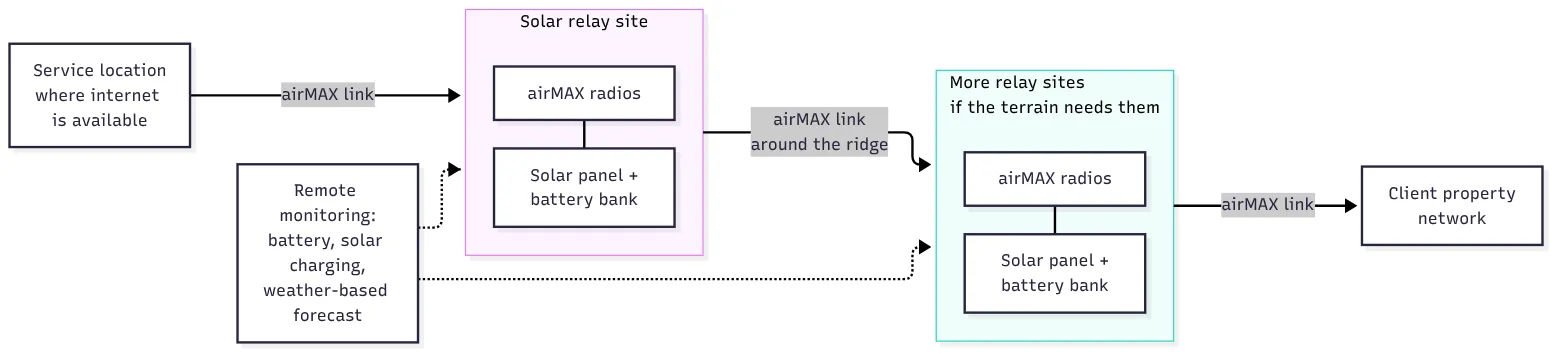 How a relayed link fits together. The number of relay sites depends on the terrain.
Relay sites are, by definition, in places nobody would run power to. So each one makes its own: a solar panel charges a battery bank, and the battery runs the radios day and night.
Here’s how I think about the design choices:
- Survey the path first. Before anything gets mounted, we walk the property and look at the line of sight between each pair of points: terrain, trees, and how they’ll grow. A relay site that only works until the next growing season isn’t a good relay site.
- Pick sites that see both ways. The best relay location isn’t always the highest one. It’s the one with a clear view of the previous hop and the next one, that we can reach to install and maintain, and that gets enough sun for its panel.
- Size the battery for winter, not summer. This is the part people underestimate, so it gets its own section below.
- Monitor everything remotely. A relay on a hilltop is a long drive and sometimes a hike away. We want to know about a problem before the link drops, not after.
Why winter decides the design
Anyone who’s lived through a North Coast winter knows the pattern: storm systems roll in and park, and you can go several days in a row with heavy overcast and very little sun. A solar panel still produces something under clouds, but not much, and the days are short.
Sizing a relay’s power system for a sunny summer week is easy. Sizing it to stay up through those multi-day stretches of little or no sun is the actual job, and it’s how we size every relay site’s battery bank: large enough to keep the radios running through a run of dark days until the panel can catch up.
A relay that drops out every time a storm stalls overhead is worse than useless, because it fails exactly when people most need to be connected.
Watching the batteries from the office
We monitor each relay site’s battery and solar charging remotely, so we’re not guessing. That includes real-time power use, a weather-based forecast, and the lowest charge the battery is expected to reach over the coming week.
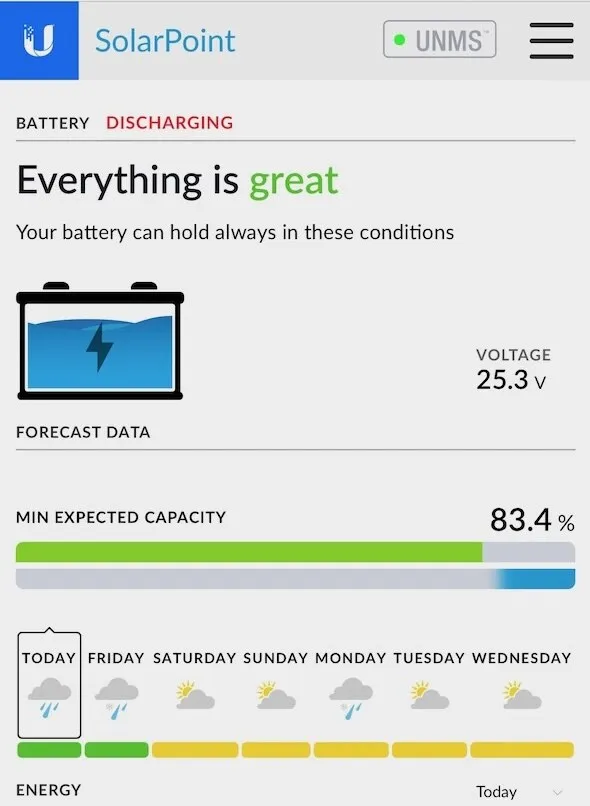 The kind of battery view we watch: current voltage, a weekly weather forecast and the lowest expected charge, from a client’s solar install in Ubiquiti’s UNMS app. App interface © Ubiquiti Inc., shown with permission.
That forecast number is the one I care about most. Current voltage tells you how things are now. The expected low for the week tells you whether there’s a problem coming, while there’s still time to do something about it.
The result
For properties where a single direct link wasn’t possible, these relayed links have given our clients stable, reliable, fast wireless connections. The terrain didn’t change, and the trees are still there. We just stopped trying to go through them.
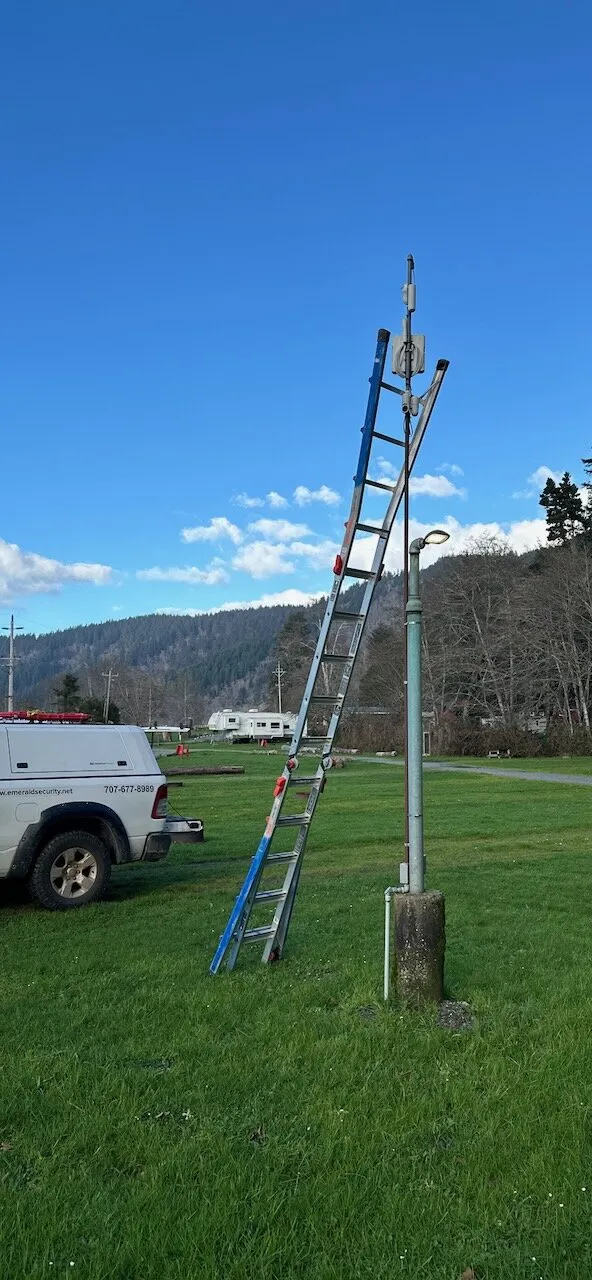 One of our point-to-point radio installs. Relay sites use the same kind of airMAX radios on their own solar power.
If you’re in the same spot
If your property can’t see the nearest source of internet, here’s what I’d think about before giving up on a wireless link:
- Where’s the closest place that has service? A neighbor, an outbuilding, or a wireless ISP’s equipment can all be a starting point.
- What’s between you and it? A single ridge or tree line might take one relay. Rougher ground might take more.
- Is there a spot that can see both ways? A clearing or high point on your land, or a neighbor’s, is often the answer. Access to that spot for installation and maintenance matters as much as the view.
- Can it run through a week of storms? If anyone quotes you a solar relay, ask how the battery was sized for winter and how it’s monitored.
- What’s the rest of the plan? A relayed link is one piece. It can sit alongside other connections for backup, and it can carry cameras and gate equipment out to places that have no wired network.
If that sounds like your property, get in touch. We’ll start with a walk of the land and a look at the path.